
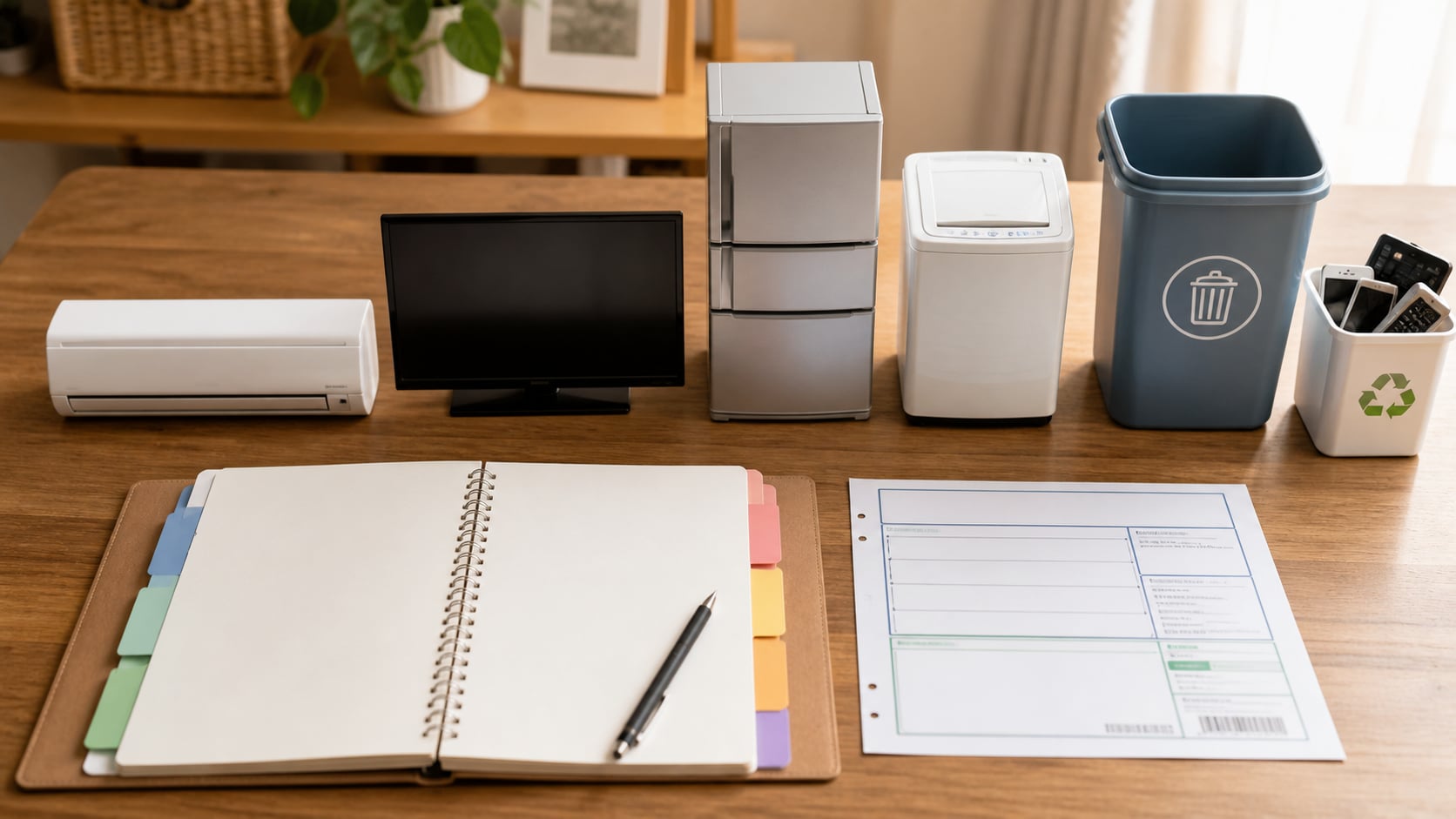
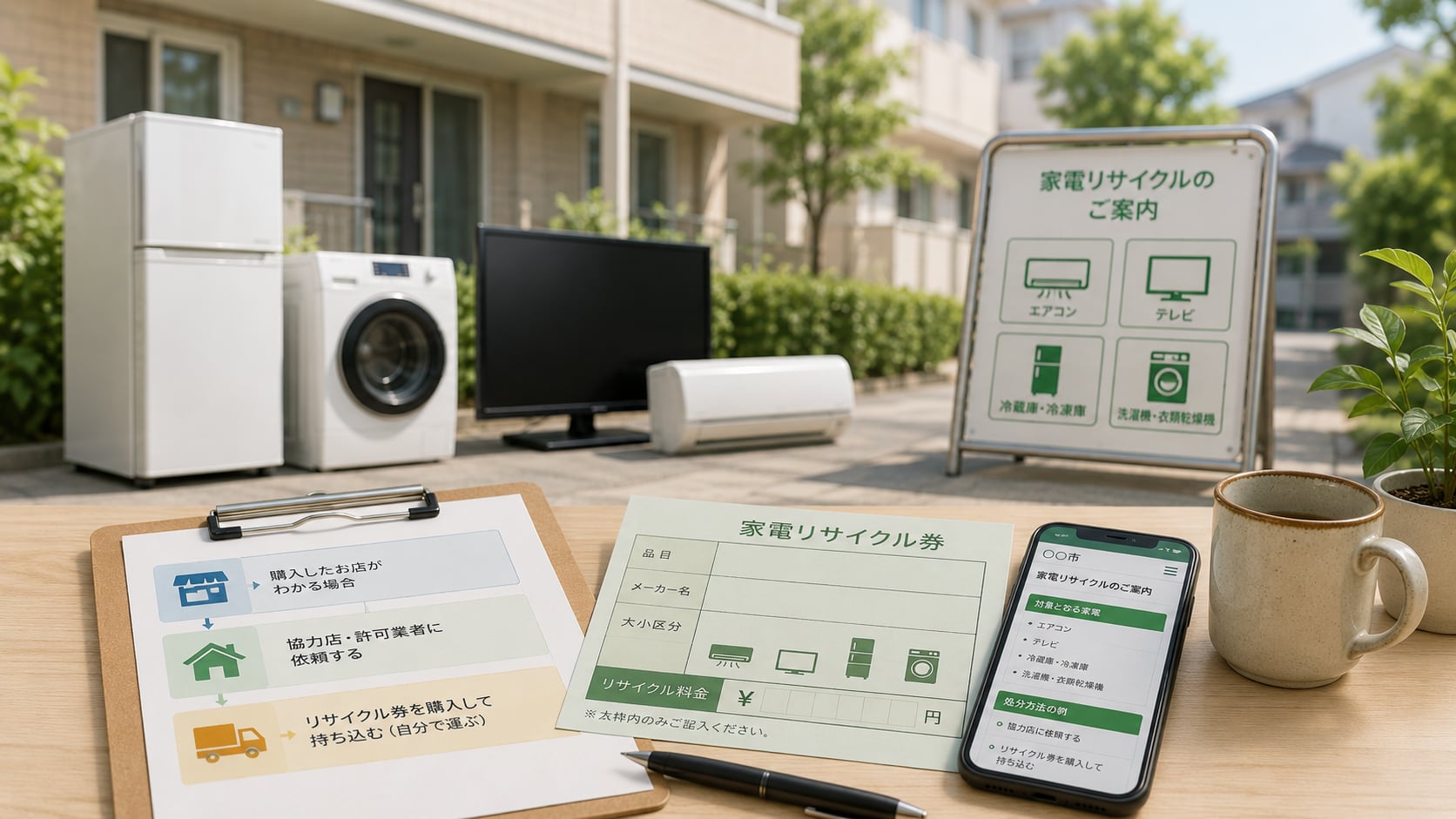
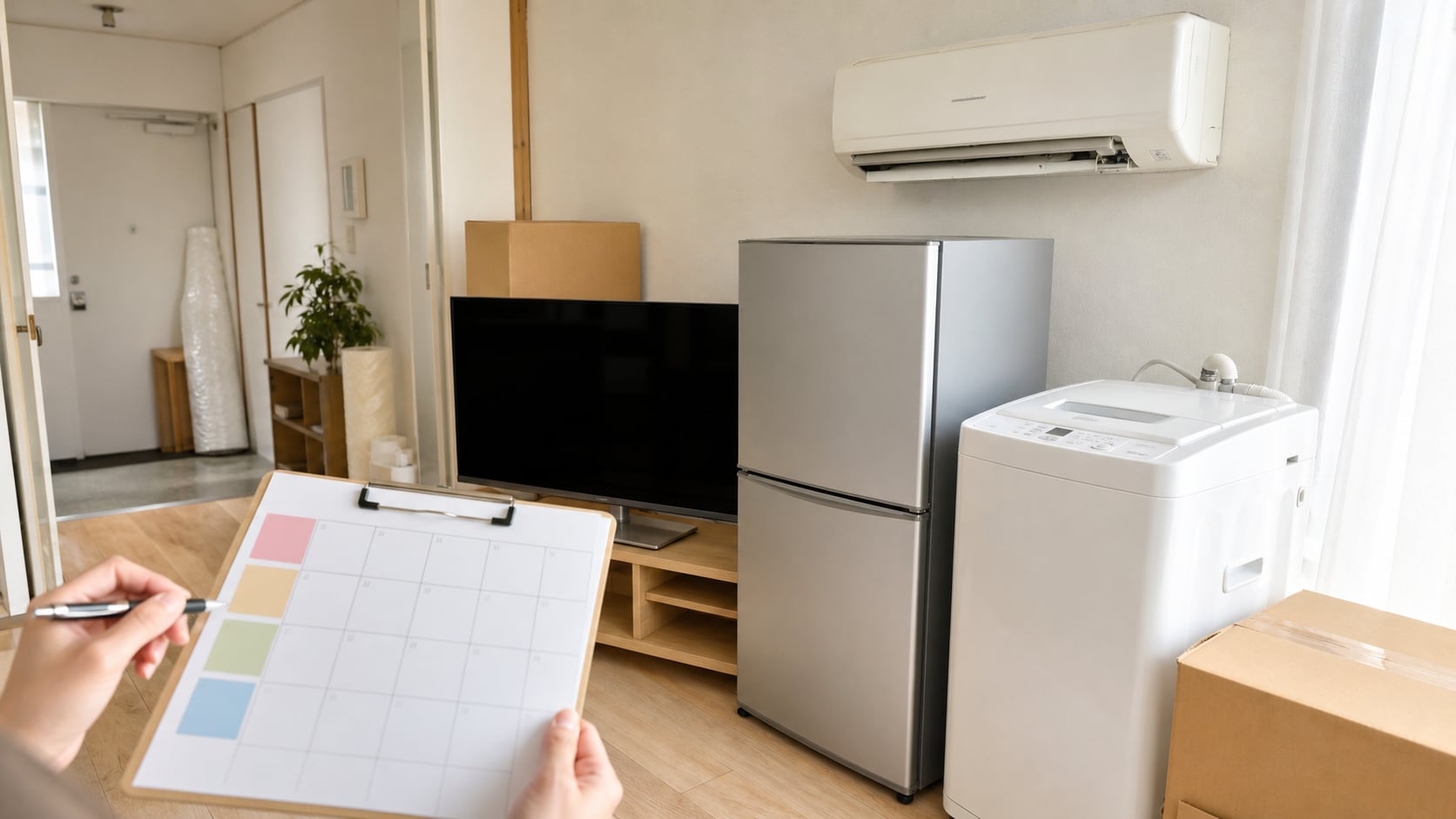
Quick Answer: Sodai gomi (粗大ごみ) is municipal oversized trash—not the same system as 家電リサイクル (Home Appliance Recycling Law) for AC, TV, fridge/freezer, and washer/dryer. Mixing the two is the #1 foreign-resident mistake. Use this glossary for short definitions, then open the linked guide for what to do next.
Series hub:
Appliance Recycling Law Guide
.
Everyday sorting:
Garbage Sorting System
.
System terms
Sodai gomi (粗大ごみ)
Municipal bulky-waste pickup—furniture, mattresses, many large items outside the four appliance categories. Fees, stickers, and booking vary by city. Not where TVs or fridges go.
→
Garbage Sorting System
Home Appliance Recycling Law (家電リサイクル法)
Law requiring proper recycling of four designated home appliances with tracking tickets and authorized handover. Separate from sodai gomi and from small home appliance boxes.
→
Hub guide
Four designated items (家電4品目)
Air conditioners, TVs, refrigerators/freezers, washing machines/clothes dryers (home use). Mini fridges often count as refrigerators—confirm locally.
→
Hub guide
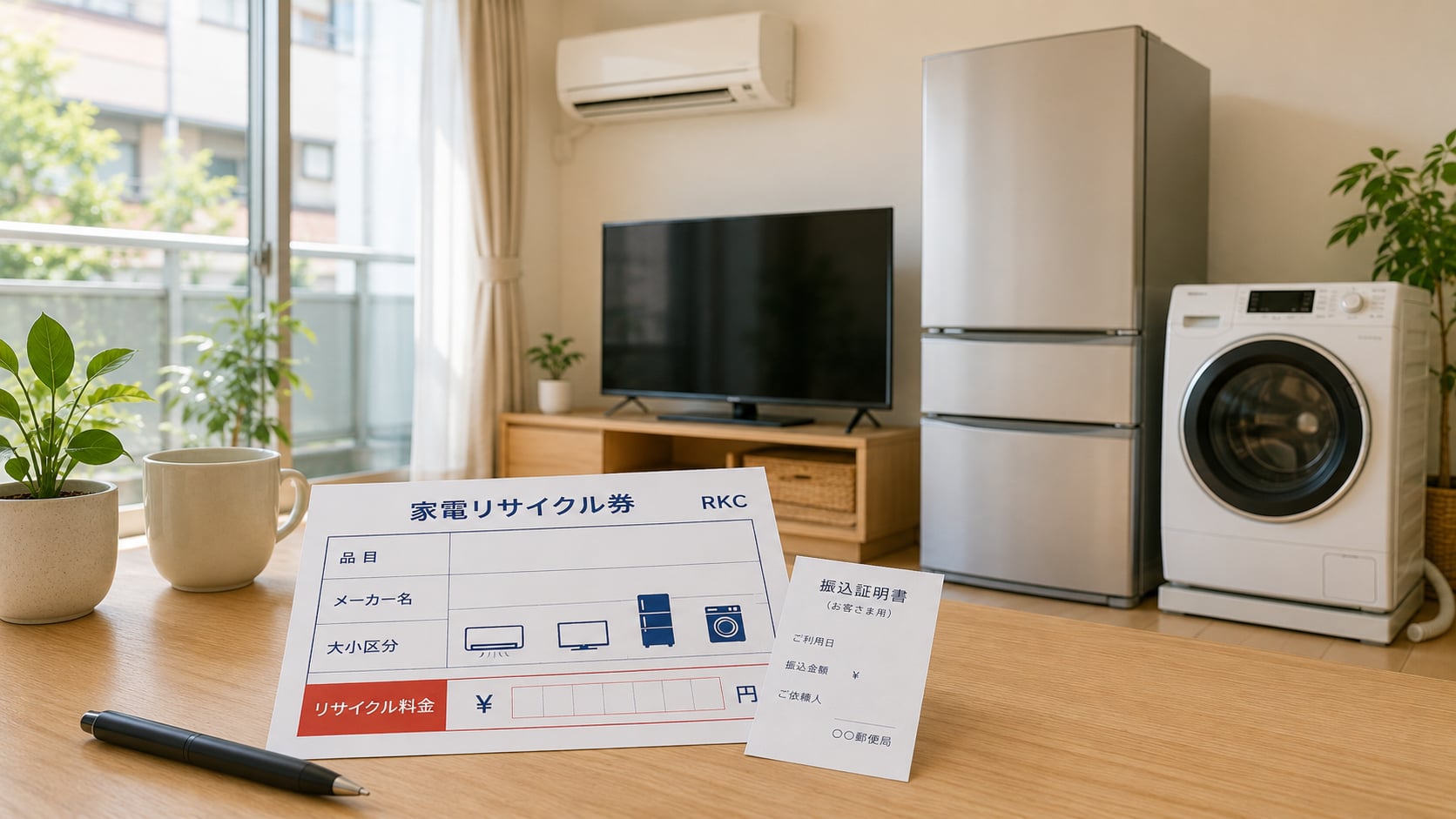
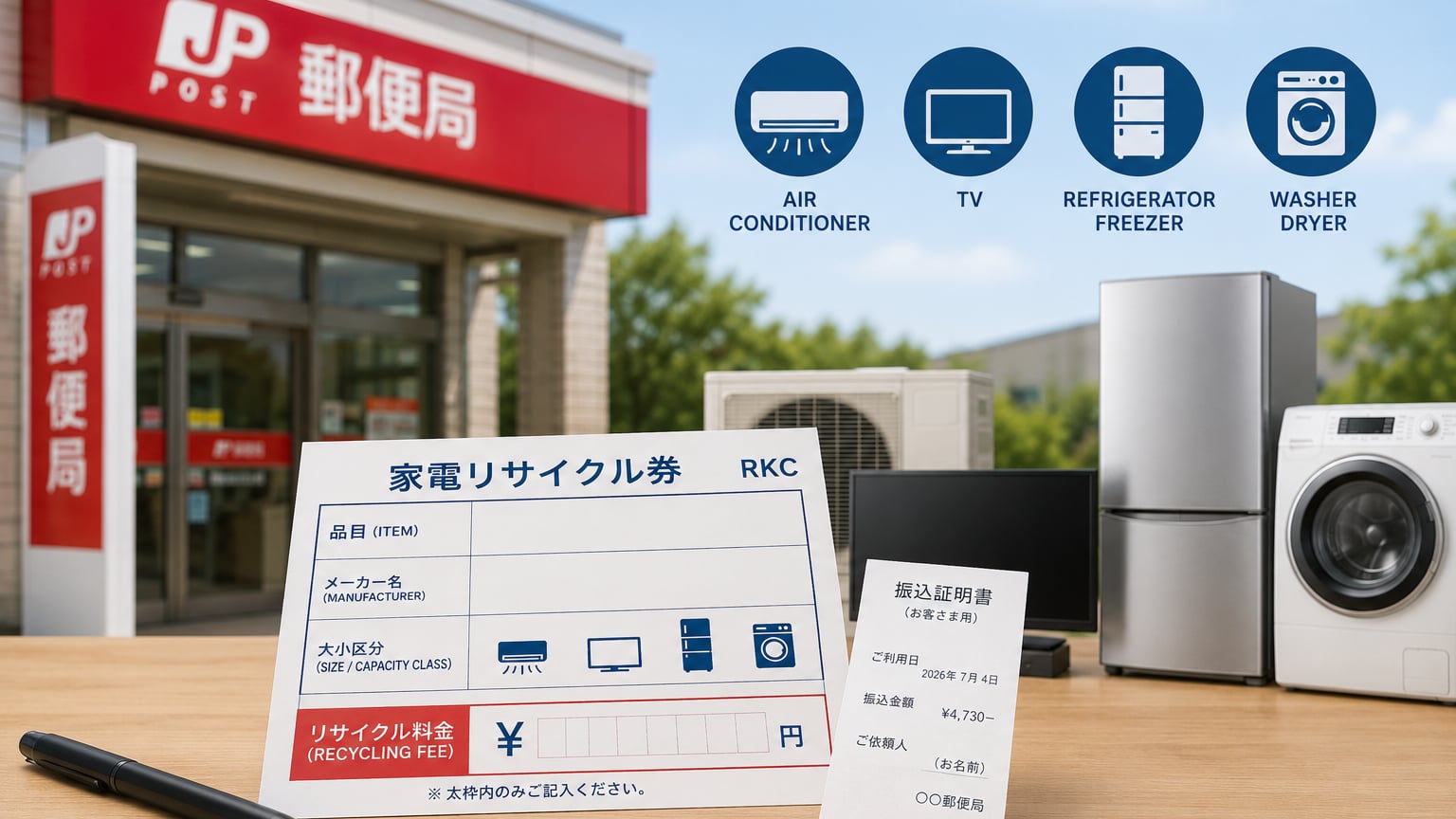
Home appliance recycling ticket (家電リサイクル券)
Payment voucher proving recycling fee paid before handover. Legally it is the 特定家庭用機器廃棄物管理票—often called a manifest or tracking slip in English summaries. One ticket per unit is typical. Use the home appliance recycling ticket stocked at post offices: pay the recycling fee at a Japan Post or Yucho counter or ATM, then self-deliver the unit to a designated site.
→
Post office ticket guide
Recycling fee (リサイクル料金)
Manufacturer-table fee for material recycling of the four items. Not the only cost—transport may be extra.
→
Hub guide — fee section
Collection / transport fee (収集運搬料金)
Charge by shop, cooperative store, or hauler to pick up or receive the unit. Varies by stairs, distance, and company.
→
Unknown store routes
Designated collection site (指定引取場所)
Facility authorized to receive ticketed appliances from consumers. Address, business days, and reception hours differ by site—confirm before you go.
→
Post office ticket guide
Manifest (マニフェスト)
Tracking document in the waste management chain. Consumers rarely fill it out themselves, but it is why tickets and licensed routes matter.
→
Unauthorized collectors
Small home appliance recycling (小型家電リサイクル)
Drop boxes / municipal programs for small electronics (phones, kettles, etc.). Not for TVs/fridges.
→ Ministry of the Environment — small appliances
Permits and unauthorized collection (一般廃棄物・古物商・産廃)
Paid pickup of household waste generally requires a general-waste collection and transport license from your municipality—or service under an official municipal contract (ward bags, city pickup).
- Purpose
- Collecting household trash for a fee
- How to use it when hiring someone
- Strong clue, not automatic proof—check the municipal name list, permit scope, and what work they may do
- Purpose
- Official city trash service
- How to use it when hiring someone
- Follow municipal guidance—confirm contract scope and what is accepted
- Purpose
- Buying/selling used goods
- How to use it when hiring someone
- No—different license
- Purpose
- Business waste
- How to use it when hiring someone
- No—not household trash
| License / system | Purpose | How to use it when hiring someone |
|---|---|---|
| General-waste collection & transport | Collecting household trash for a fee | Strong clue, not automatic proof—check the municipal name list, permit scope, and what work they may do |
| Municipal contract / designated bags | Official city trash service | Follow municipal guidance—confirm contract scope and what is accepted |
| Secondhand dealer (古物商) | Buying/selling used goods | No—different license |
| Industrial waste permit (産廃) | Business waste | No—not household trash |
📌 Retailer take-back under the Home Appliance Recycling Law (purchase-store route) is a separate path from general-waste hauler permits above.
→
Unauthorized collectors guide
Unauthorized collection (無許可回収)
Operators without proper local authorization—risk of illegal dumping and fee fraud. Not every cheap pickup is unauthorized, but verify permit numbers before loading.
→
Unauthorized collectors guide
Situation terms
Mini-fridge
Often treated as a refrigerator-class item for recycling—not regular sodai gomi. Check your ward page.
→
Hub FAQ
No car (車なし)
Self haul to designated sites may be hard—cooperative shop pickup or licensed collectors become realistic.
→
Unknown store routes
Smart TV — factory reset (初期化)
Clear accounts before disposal; photograph model labels before cleaning or disassembly.
→
Disassembly caution
Moving company (引越し業者)
May refuse or charge separately for four-item recycling. Ask in writing what is included.
→
Move-out timeline
Sayonara sale / JMTY / recycle shop
Ways to pass on working units when you have time. Broken units still need legal recycling.
→
Move-out timeline
Free pickup truck (無料回収トラック)
Street or parking-lot collectors advertising free removal. Verify license before use.
→
Unauthorized collectors
Cooperative store (協力店)
Local shop that can collect/transport appliances for a fee when purchase-store route fails. Lists are municipality-specific—no nationwide directory.
→
Unknown store routes
Indoor / outdoor AC unit (室内機 / 室外機)
Room AC disposal usually treats indoor + outdoor set. Do not assume outdoor unit is sodai gomi.
→
Hub guide
Where to go next
| Your question | Read |
|---|---|
| What is the overall flow? |
Hub guide
| | Japan Post tickets? |
Post office guide
| | Bought used / no receipt? |
Unknown store
| | Took TV apart? |
Disassembly caution
| | Move-out next week? |
Timeline
| | Sketchy hauler ad? |
License check
|
Frequently asked questions
What is the difference between appliance recycling and small home appliance recycling?
Appliance recycling (four items) covers AC, TV, fridge/freezer, and washer/dryer with tickets and authorized handover. Small home appliance recycling is for small electronics (phones, kettles, etc.) via drop boxes or municipal programs—not for TVs or fridges. Start with the
hub guide
for the four items.
Can I put a TV or fridge out as sodai gomi?
Usually no. Sodai gomi is municipal oversized trash for many bulky items, but the four designated appliances need recycling tickets and legal routes. A mini-fridge is often still refrigerator-class, not regular sodai gomi—confirm on your ward’s official page.
I do not understand a Japanese term on a flyer or shop receipt—what now?
Bookmark this page, find the term above, then open the linked guide for step-by-step actions. For fees, check RKC consumer information and your retailer or cooperative store—do not rely on fixed amounts from blogs.
Where should I read next for full instructions?
Use the link map table: overall flow → hub guide; Japan Post → post office guide; no purchase store → unknown-store guide; move-out deadline → timeline; sketchy pickup → license guide.
What to do next
- Identify whether your item is one of the four designated appliances or something else (sodai gomi / small appliance box).
- Open the matching series guide from the table above—do not mix routes.
- Confirm recycling fee + transport fee separately with the shop or site you will use.
- Keep this glossary open while you call shops or read municipal pages in Japanese.
Sources
- Ministry of the Environment — Home Appliance Recycling Law (verified 2026-07-04)
- RKC — Consumer portal (verified 2026-07-04)
- AEHA — Consumer route chart (Japanese) (verified 2026-07-04)