
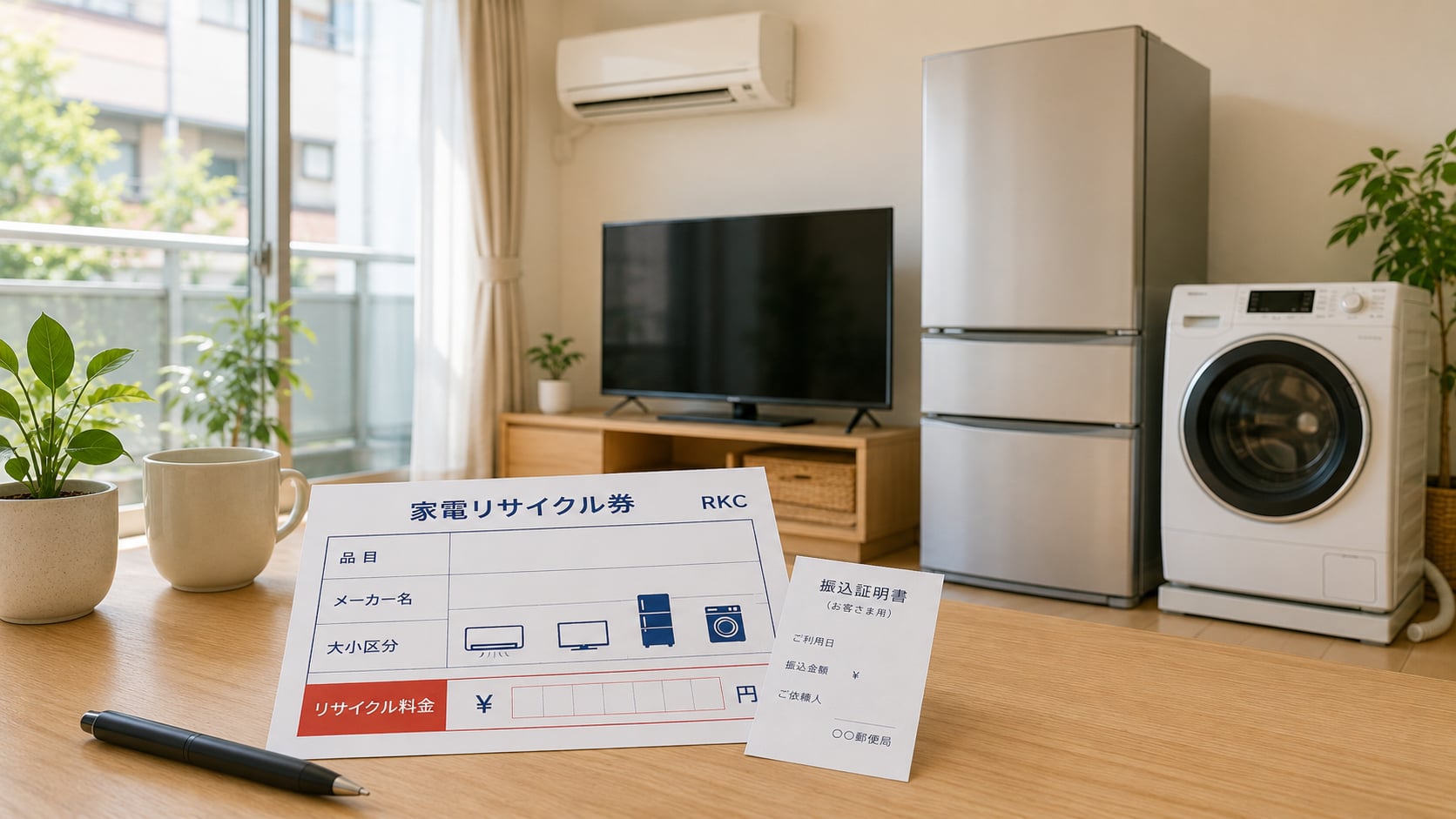
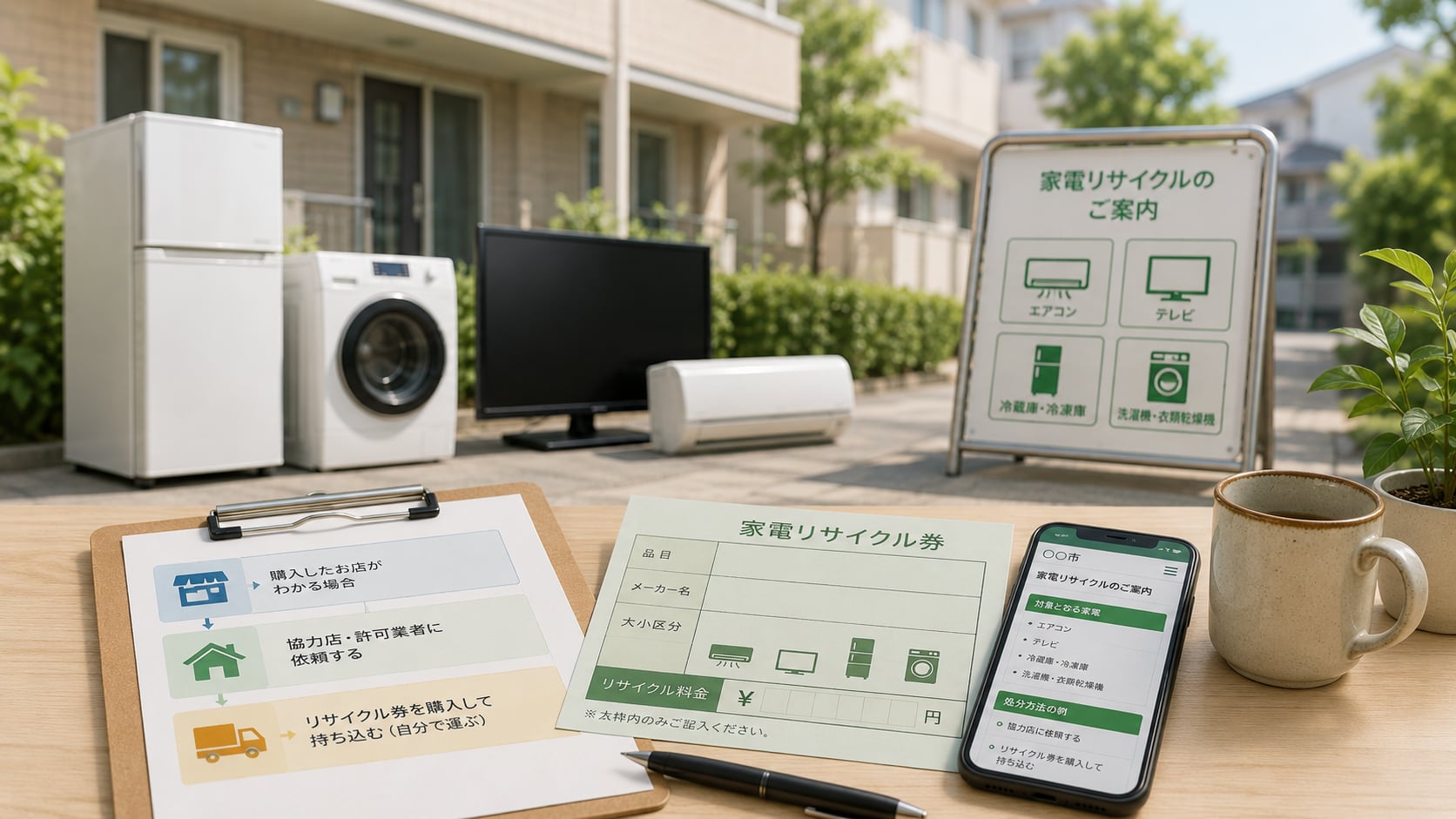
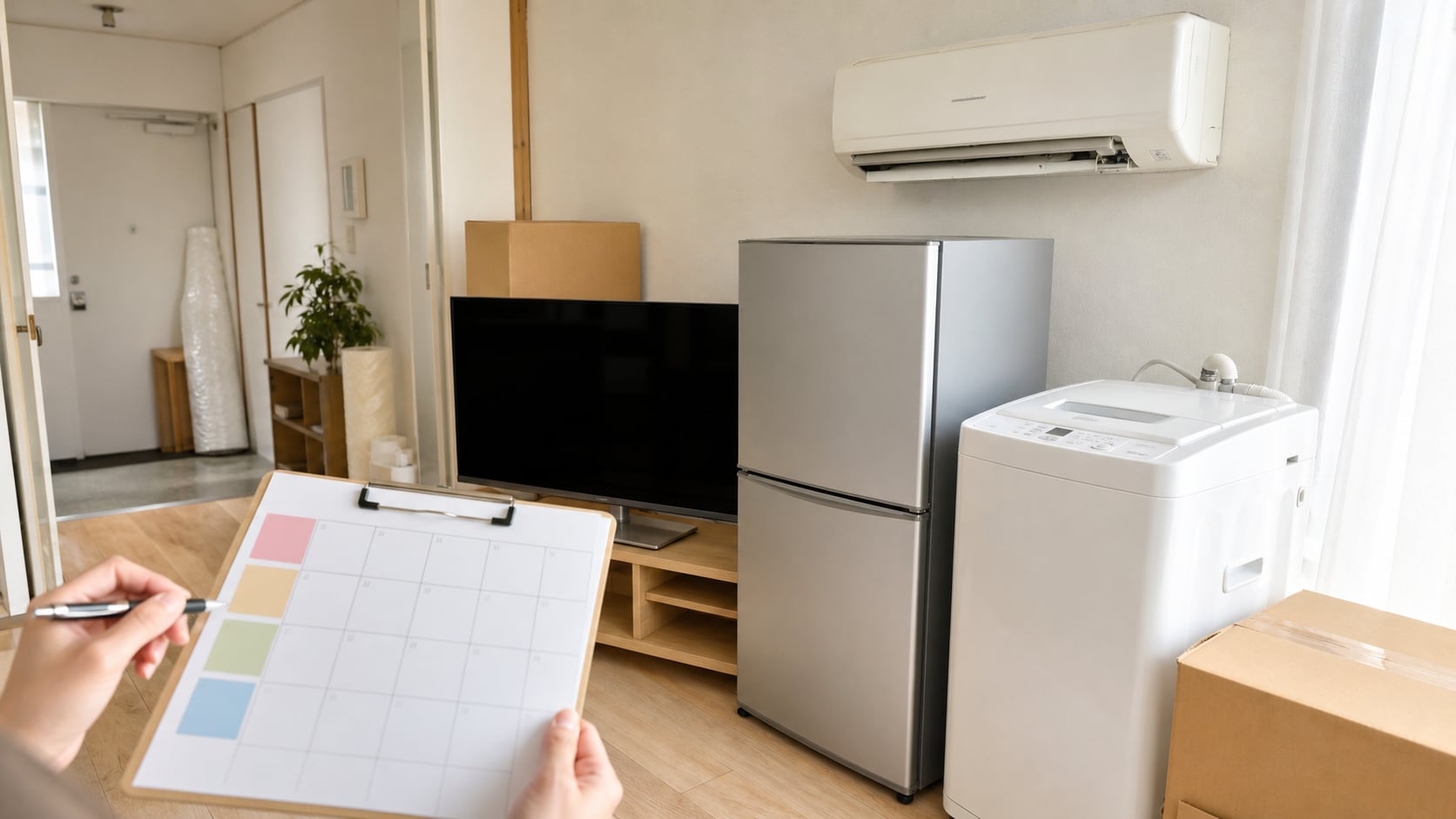
Quick Answer: Home appliance recycling in Japan (disposing of air conditioners, TVs, refrigerators, and washers)—hub guide if you want to organize your options before a move or move-out. These items usually cannot go out as sodai gomi; hand them over through a method that complies with the Home Appliance Recycling Law.
Who is this for?
- Moving or leaving a home and wondering what to do with major appliances
- Want to understand disposal options for air conditioners, TVs, refrigerators, and washers from the start
Related articles
If any of these apply, read the linked guide.
- Can transport the appliance by car and want to buy a recycling ticket at Japan Post →
Recycling Ticket at Japan Post
- Do not know the purchase store, or have no car and need a cooperative store →
Disposal When the Store Is Unknown
- Already took a unit apart, or worry about nameplate / model labels before drop-off →
Disassembly and Collection Refusals
- Move-out is soon and you need a priority order for the four items →
Moving-Out Disposal Timeline
- Saw a “free pickup” truck or online ad and want to check if it is legitimate →
Unauthorized vs Licensed Collectors
- Confused by Japanese terms such as sodai gomi, recycling ticket, or cooperative store →
Appliance Recycling Glossary
For everyday trash and sodai gomi in general, see
Japan’s Garbage Sorting System
.
Why can’t these go out as sodai gomi?
Sodai gomi (粗大ごみ) is your municipality’s system for bulky items such as furniture and bicycles.
The following four item types fall under a separate law (the Home Appliance Recycling Law) and cannot be disposed of under sodai gomi rules
- Air conditioners
- Televisions
- Refrigerators and freezers
- Washing machines and clothes dryers
📌 Heavy does not mean sodai gomi. TVs and refrigerators are often rejected if placed out without the proper procedure—check your municipality’s guidance first.
Phones, kettles, and other small electronics use a different recycling system. This series covers only the four items above.
Cultural note: Under the Home Appliance Recycling Law, consumers, retailers, and manufacturers each have a role. Consumers pay recycling and collection/transport fees and hand units to retailers or designated collection sites so materials reach manufacturer recycling programs.
Mini fridges are often still covered
A compact or mini fridge is not automatically sodai gomi just because it is small. Many household mini fridges are treated as refrigerators under the four designated items.
Check your municipality’s official page before disposing. Try searches such as
municipality name 家電リサイクルormunicipality name 小型家電 回収- Your city/ward site → garbage / waste / recycling → appliances
Three main disposal methods
Pick the row closest to your situation, then follow the linked article.
- Best when
- You know where the unit was bought and the store is still open
- Detailed guide
- See Method A below
- Best when
- You can transport the unit by car or rental van
- Detailed guide
| Method | Best when | Detailed guide |
|---|---|---|
| A. Purchase store | You know where the unit was bought and the store is still open | See Method A below |
| B. Post office + self delivery | You can transport the unit by car or rental van |
Post office recycling ticket
| | C. Municipality + cooperative store | Purchase store unknown, secondhand/gift unit, or no car |
When the store is unknown
|
📌 There is no single nationwide phone number that solves everything. Cooperative store names and availability differ by municipality.
Method A: Ask the purchase store for take-back
When you buy a replacement, the retailer often collects the old unit on delivery. Even without a replacement, it is worth calling a nearby electronics store to ask whether they accept take-back for a fee.
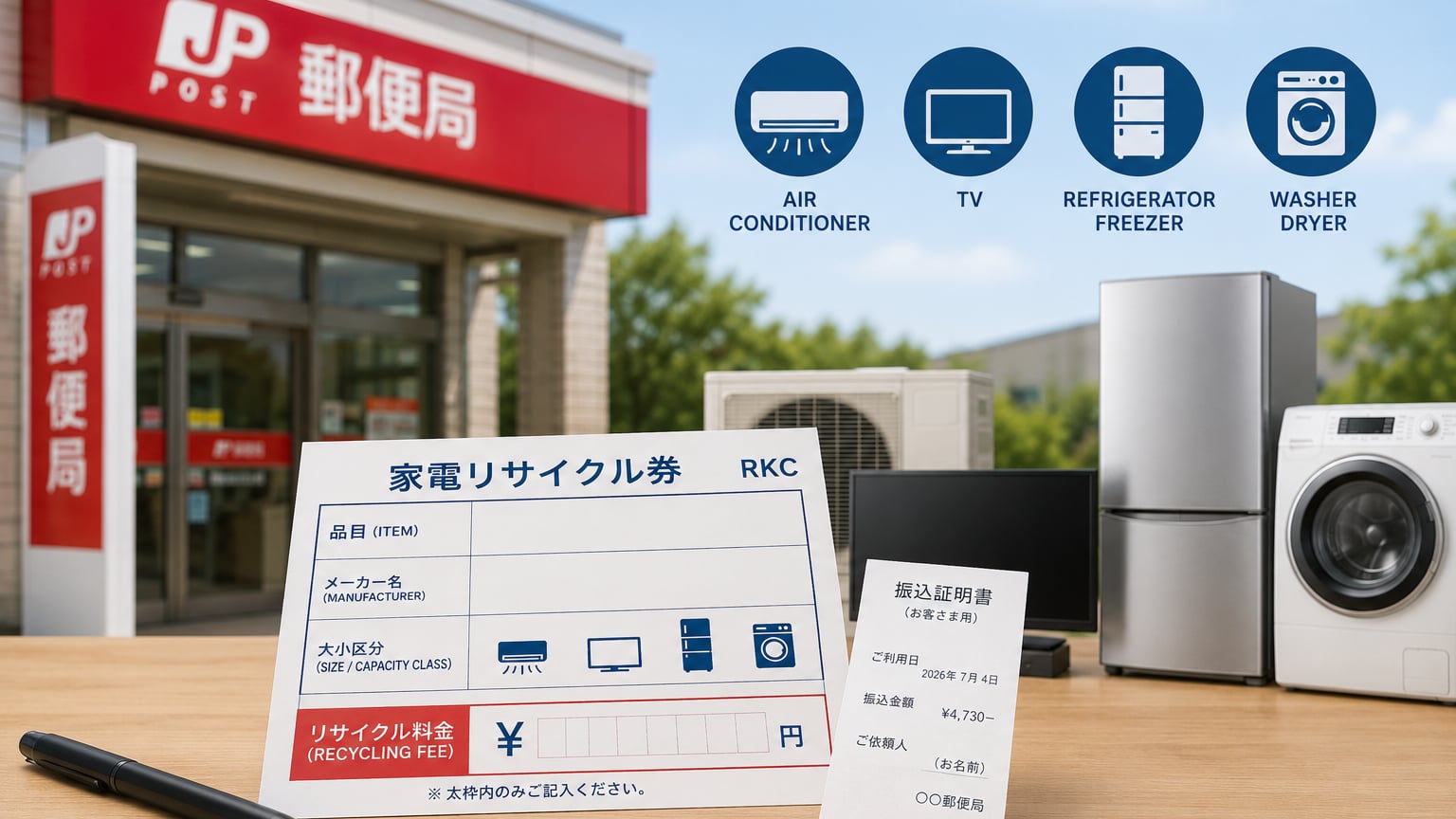
Method B: Buy a ticket at the post office and deliver yourself
At Japan Post or Yucho Bank you can buy a home appliance recycling ticket, then take the unit to a designated collection site yourself. This suits people who have a car. Step-by-step:
dedicated guide
.
Method C: Find a cooperative store via municipality guidance
Bought secondhand, inherited from a previous tenant, or purchased from a distant store—start on your municipality’s official 家電リサイクル page. It may list cooperative stores for pickup or licensed haulers. Details:
when the store is unknown
.
Two types of fees
- Recycling fee — set by manufacturer and size class
- Collection/transport fee — added when someone picks up from your home (varies by method and provider)
Self delivery usually centers on the recycling fee. Home pickup often adds collection/transport.
Why do totals vary so much?
There is no single national price. Totals change with factors such as
- Point
- Different fee tables for TV, fridge, washer, etc.
- Point
- Screen size or capacity class affects recycling fee
- Point
- Pickup often adds transport charges
- Point
- Upper floors without an elevator may add carry fees
- Point
- Store, cooperative shop, or hauler quotes differ
| Factor | Point |
|---|---|
| Item type | Different fee tables for TV, fridge, washer, etc. |
| Manufacturer & size | Screen size or capacity class affects recycling fee |
| Self delivery vs pickup | Pickup often adds transport charges |
| Floor access | Upper floors without an elevator may add carry fees |
| Who you hire | Store, cooperative shop, or hauler quotes differ |
Check RKC fee search and get a quote before booking.
Do you need a car?
- Practical option
- Buy a ticket at the post office and deliver to a designated site
- Practical option
- Ask a cooperative store or licensed hauler for pickup
- Practical option
- Clear the four designated items before furniture and boxes — see
| Your situation | Practical option |
|---|---|
| Have a car or rental van | Buy a ticket at the post office and deliver to a designated site |
| No car | Ask a cooperative store or licensed hauler for pickup |
| Moving soon | Clear the four designated items before furniture and boxes — see |
moving-out timeline
|
Common mistakes
- Putting a TV or fridge out as sodai gomi — often rejected
- Disassembling before drop-off — if maker/model labels (nameplate / model label) become unreadable, acceptance may be refused — see
disassembly caution
- Using “free pickup” trucks without checking licenses — may be unauthorized operators — see
collector checklist
- Waiting until the day before move-out — tickets and bookings can take days or weeks
Can you sell a working unit instead?
If the appliance still works and you can store and ship it yourself, selling on a flea-market app may be worth trying before you pay recycling fees (check Mercari size rules and listing restrictions). See
How to sell on Mercari in Japan
. If it does not sell or you still need legal disposal, continue with the method articles in this series.
What to do next
- Confirm the unit is an air conditioner, TV, refrigerator, or washing machine
- Check whether you know the purchase store and whether you have transport
- Pick a method from the table above and open the linked article
Frequently asked questions
Can I put a mini fridge out with sodai gomi?
Usually not. Confirm on your municipality’s official page before acting.
What if I am not confident in Japanese?
Post offices and local shops are often Japanese-only. Write manufacturer, item type, and size class on paper to bring with you. Phrase lists are in the English versions of the method-specific articles.
Sources
- Ministry of the Environment — Home Appliance Recycling Law overview (four items) (verified 2026-07-04)
- Ministry of Economy, Trade and Industry — Home appliance recycling portal (verified 2026-07-04)
- Appliance Recycling Ticket Center (RKC) — For consumers (verified 2026-07-04)
- Association for Electric Home Appliances (AEHA) — Consumer disposal guide (verified 2026-07-04)