
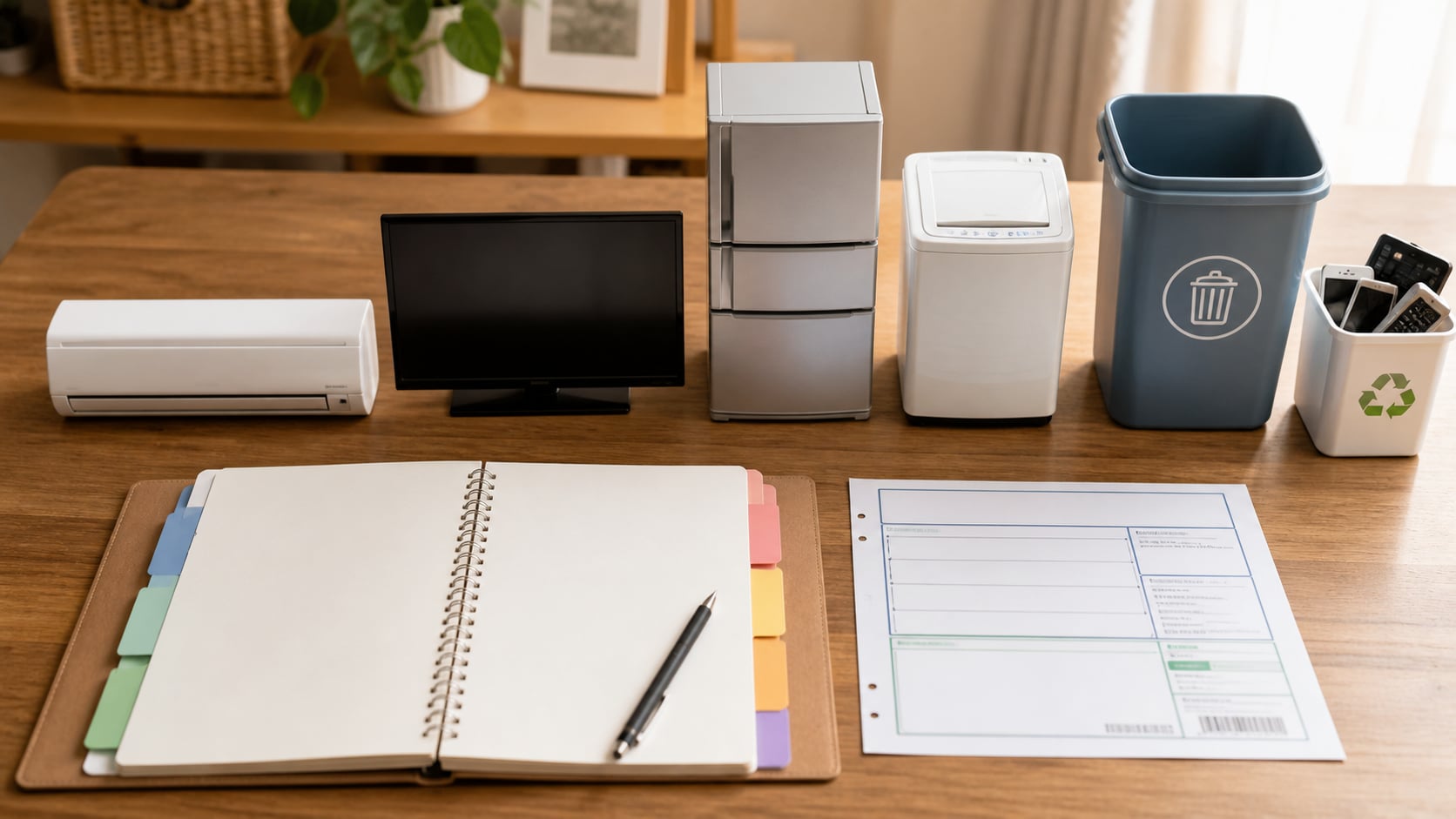
Quick Answer: Taking apart a TV or other designated appliance before drop-off can cause problems at collection—even though disassembly is not automatically illegal and sites do not always refuse broken-down units. Common issues: hidden maker/model labels, harder safe transport, and ticket details that no longer match what staff see. Call the designated site or shop first, photograph labels before any disassembly, and wipe smart-TV accounts without destroying the nameplate.
This is a checklist from real friction, not legal advice. Hub:
Appliance Recycling Law Guide
.
What happened in one real case?
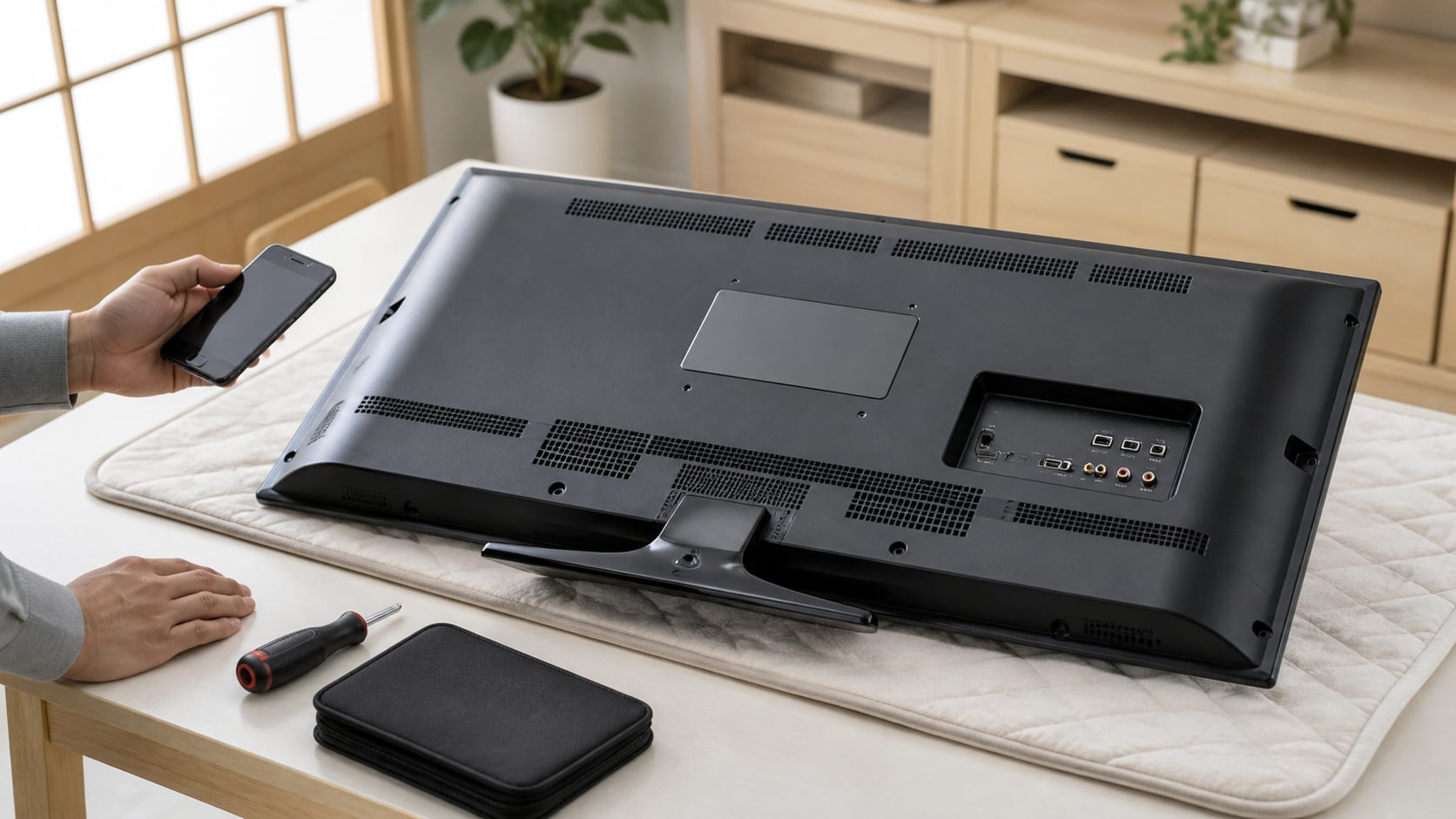
A contributor disassembled a large TV to fit it into a car for self drop-off at a designated site. Staff declined to accept the unit as presented. After rebooking through another route, the total cost was ¥9,020.
📌 Treat that as one story, not a national fee table or a rule that every site refuses disassembled TVs. Your municipality, ticket details, and staff on duty can change the outcome.
Why might a collection site say no?
Sites and cooperative shops follow RKC ticket rules and their own safety and intake procedures. Problems often cluster around:
- Why staff care
- Fee class and ticket matching
- Why staff care
- Unclear whether all parts are present; transport damage risk
- Why staff care
- Worker safety
- Why staff care
- Administrative mismatch
- Why staff care
- Extra handling rules for some facilities
| Issue | Why staff care |
|---|---|
| Nameplate / model label hard to read | Fee class and ticket matching |
| Unit in many pieces | Unclear whether all parts are present; transport damage risk |
| Sharp edges or loose panels | Worker safety |
| Ticket written for “one TV” but parts arrive separately | Administrative mismatch |
| CRT / glass exposure | Extra handling rules for some facilities |
None of this means every disassembled unit is rejected—but it explains why asking first beats guessing.
Is disassembly banned by law?
Do not write “disassembly is illegal.” The Home Appliance Recycling Law framework focuses on proper recycling routes and fees, not on whether you may unscrew a stand at home.
Practical advice: keep the unit in the condition the site expects, or get written/verbal OK before you alter it.
Smart TV: protect data without hiding the label
Before disposal (whether or not you remove the stand):
- Sign out of streaming and app accounts
- Run factory reset (初期化) per the maker FAQ
- Photograph the model label and serial before cleaning products cover text
- Keep photos in case the ticket office questions spelling
Maker examples (Japanese):
- Sharp — before disposal / transfer (verify current page)
- Search your brand: メーカー名 + 廃棄 初期化
For vocabulary used in tickets and shop calls, see the key terms section in the
Appliance Recycling Law Guide
.
Opened it for repair? Missing parts can change the answer
Another contributor tried the purchase-store route: they brought a TV to a major electronics chain hoping for repair, opened the back cover, then lost screws and could not close the panel. The shop declined to take the unit for disposal or repair handoff in that condition.
📌 This is one store interaction, not proof that every retailer refuses partially opened TVs. It shows why “take it to where you bought it” is not automatic relief if the unit is modified, incomplete, or unsafe to move.
Before opening anything:
- Call the shop and describe the symptom—ask whether walk-in repair intake is possible
- If you open the case, bag and label every screw; photograph reassembly steps
- If the shop says no, switch to municipality-listed routes—see
Disposal When the Store Is Unknown
- For recycling intake, do not strip parts for spare sales unless a licensed route agrees in advance
If you want parts or repair instead of recycling
- Realistic first step
- Maker service center or authorized repair shop (fees vary)
- Realistic first step
- Reuse shops or listings—only when you have time before move-out
- Realistic first step
- Cooperative shop, ticket + designated site, or licensed pickup
| Goal | Realistic first step |
|---|---|
| Fix it | Maker service center or authorized repair shop (fees vary) |
| Sell or donate working units | Reuse shops or listings—only when you have time before move-out |
| Recycle legally | Cooperative shop, ticket + designated site, or licensed pickup |
Parts-only recycling pickup is rarely offered for designated appliances. Treat “take just the panel” requests as unlikely unless staff explicitly agree.
What to do if collection is refused
- Ask why (label, safety, ticket mismatch, missing pieces)—take notes
- Photograph labels and the unit as-is
- Try another cooperative shop or designated site after calling ahead
- Ask your municipality’s waste desk (清掃課 / 環境課) for the current list—wording varies by city
- Under time pressure, read
Move-Out Disposal Timeline
and avoid unlicensed “free” trucks—
license check guide
Safer prep checklist (instead of full tear-down)
- Remove stand or wall mount only if the site confirms that is OK
- Tape loose cables to the back; do not tape over labels
- Empty batteries/remotes go with small-electronics rules locally—not stuffed inside the TV box
- Transport upright when possible; pad corners
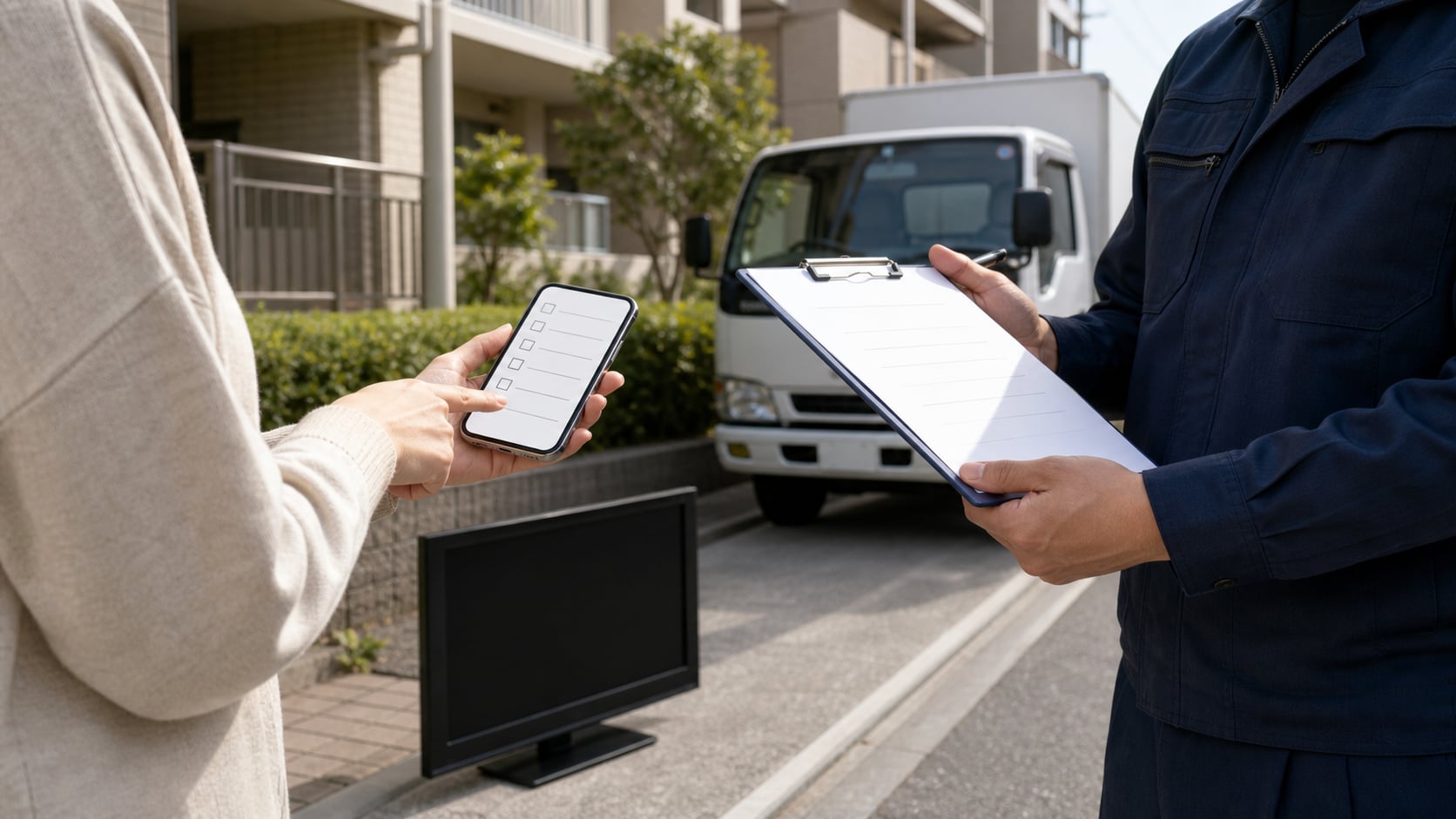
- Bring ticket + payment proof + ID if the site asks
If the TV does not fit your vehicle, compare shop pickup vs rental van vs disassembly—pickup may cost more but avoids label damage.
Useful Japanese phrases
- Japanese
- スタンドだけ外して持ち込んでもいいですか
- Romaji
- Sutando dake hazushite mochikonde mo ii desu ka
- Japanese
- 型番ラベルの写真があります
- Romaji
- Kataban label no shashin ga arimasu
- Japanese
- 先ほど引き取りを断られました
- Romaji
- Sakihodo hikitori wo kotowaremashita
- Japanese
- この状態でリサイクル引き取りは可能ですか
- Romaji
- Kono joutai de risaikuru hikitori wa kanou desu ka
| English | Japanese | Romaji |
|---|---|---|
| Can I remove the stand only? | スタンドだけ外して持ち込んでもいいですか | Sutando dake hazushite mochikonde mo ii desu ka |
| I have photos of the model label | 型番ラベルの写真があります | Kataban label no shashin ga arimasu |
| The unit was refused earlier | 先ほど引き取りを断られました | Sakihodo hikitori wo kotowaremashita |
| Can you accept it for recycling in this condition? | この状態でリサイクル引き取りは可能ですか | Kono joutai de risaikuru hikitori wa kanou desu ka |
What to do next (short)
- Confirm maker/model photos and whether the site accepts your unit as-is
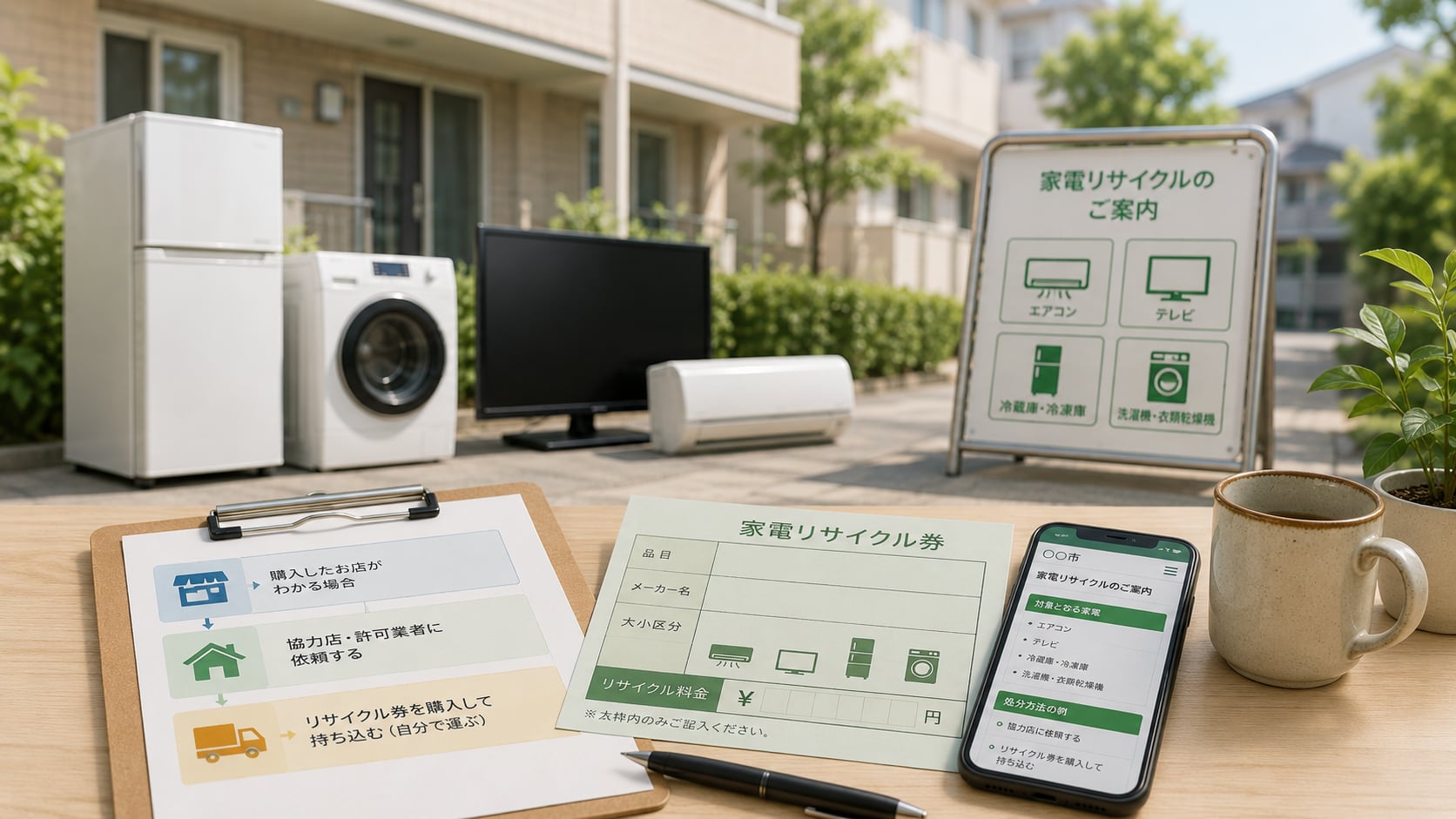
- Book shop pickup or designated-site hours; if self-hauling, pay the recycling fee at a post office and prepare the ticket
- If refused, switch routes—do not keep disassembling without a new OK
Frequently asked questions
Can I recycle only spare parts?
Usually not through standard appliance recycling intake. Shops expect a whole designated item with identifiable labels unless they explicitly agree otherwise.
My appliance is broken but still one piece—is that OK?
Often yes, if labels are readable and the unit can be moved safely—but acceptance is site-specific. A cracked screen or missing door may trigger extra questions; call ahead.
What if collection is refused?
Try another listed route, adjust presentation (secure doors, reunite parts), or ask the municipal waste desk. See
Unknown Store Routes
for branching options.
Should I disassemble to save money?
Only if the site or shop confirms acceptance. Otherwise you risk paying twice—wasted trip plus rebooking fees.
What if the label is missing?
Recovery is hard. Cooperative shops sometimes help identify units, but fees and acceptance vary. Start with photos of any remaining marks before stripping parts.
Does this apply to fridges and washers?
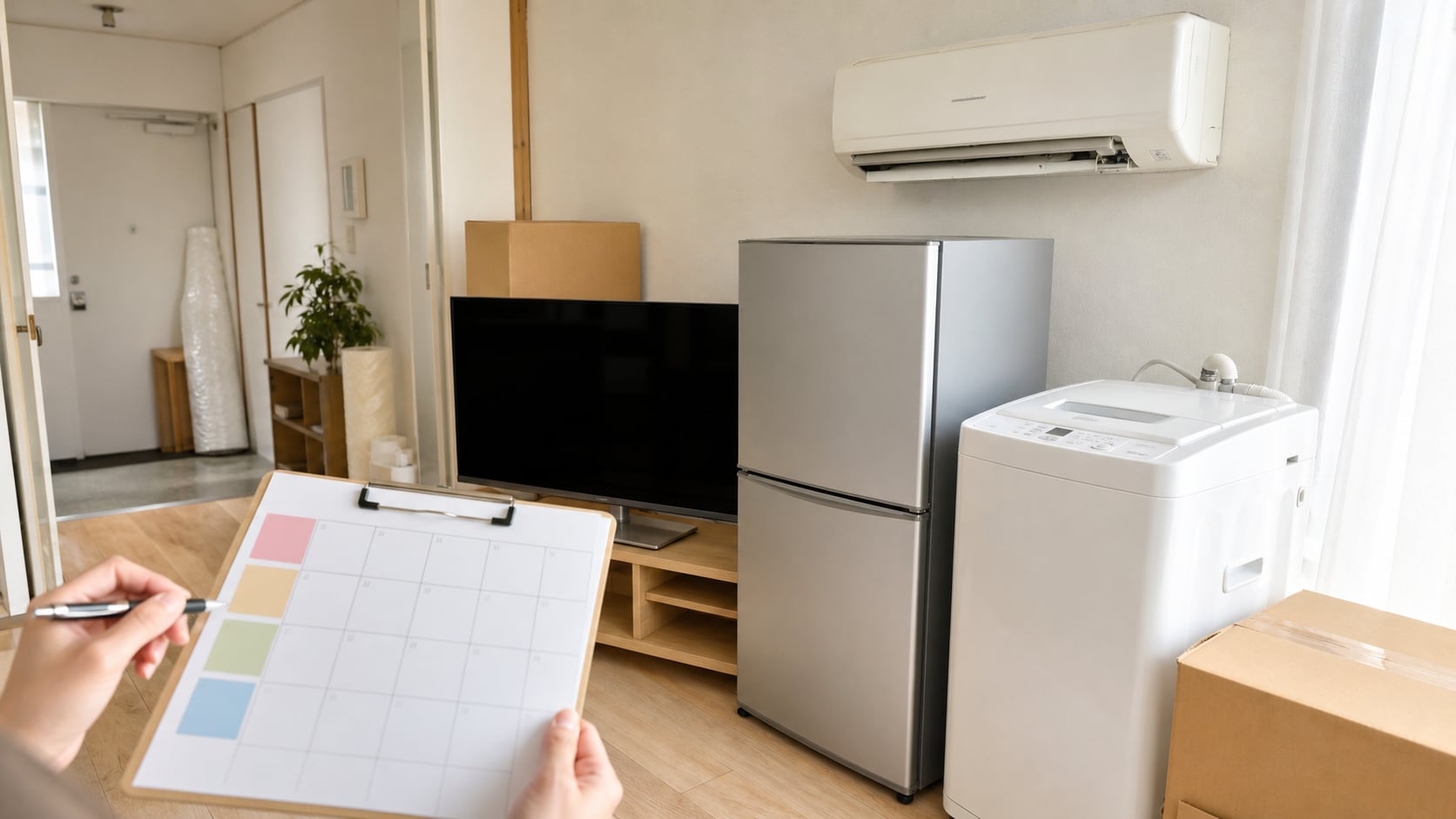
Similar label and safety issues apply. Fridge doors should be secured; washer drums are heavy—follow site guidance. Ticket article:
Post Office Recycling Ticket
.
Sources
- RKC — Ticket writing guide (verified 2026-07-04) — label visibility requirements
- Ministry of the Environment — Four designated items (verified 2026-07-04) — legal framework (not disassembly bans)
Appliance Recycling Law Guide (this series)
— route overview