
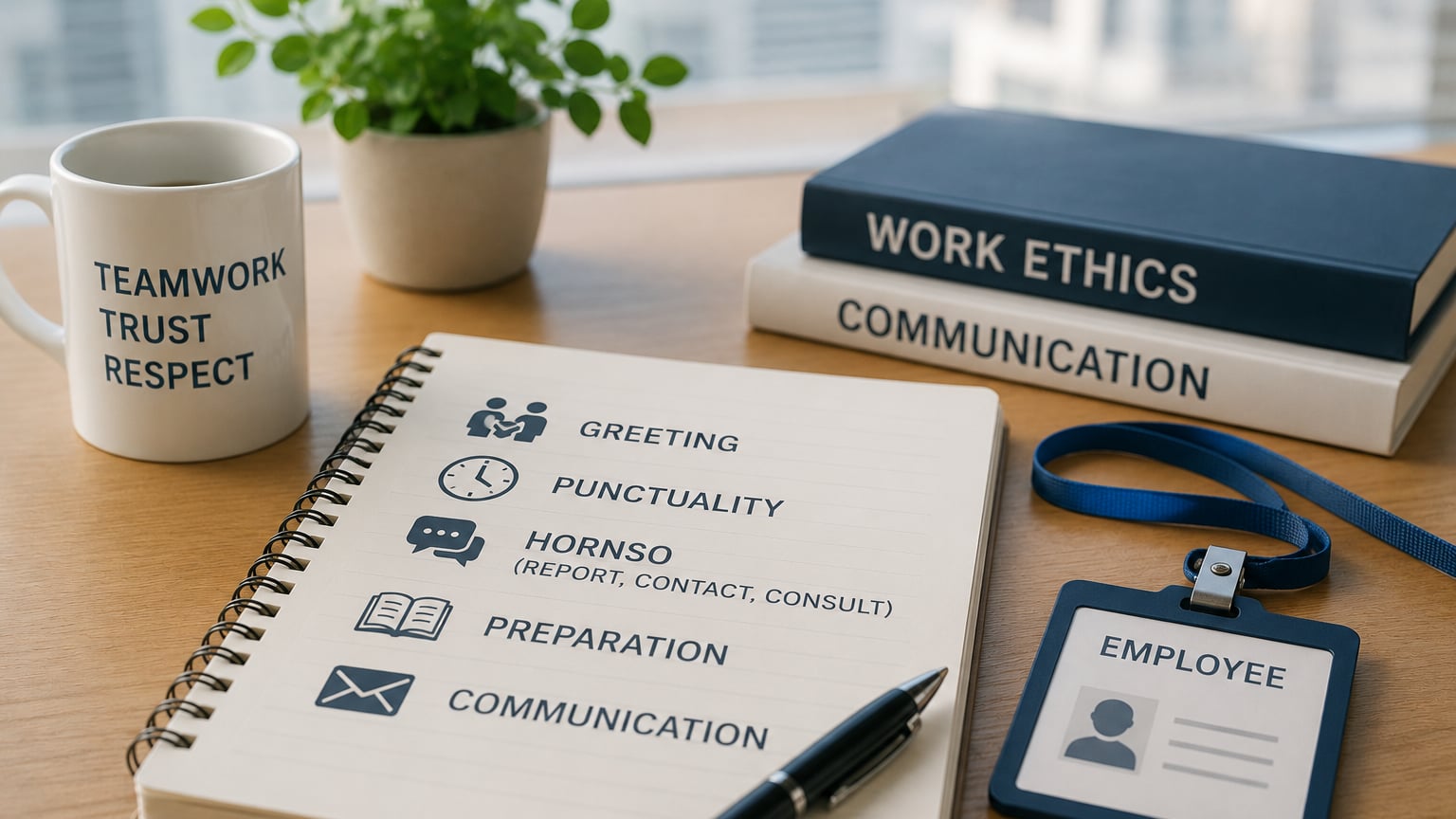


Quick Answer: Japanese workplace manners start with greetings, punctuality, reporting and consultation (horenso), meeting preparation, polite email, and language suited to the other person’s role. Company culture varies widely by industry, generation, and whether the firm is domestic or international—observing how your workplace operates in the first month and asking early questions usually matters more than memorizing one fixed rulebook. Expectations on overtime and drinking events also differ by employer.
What should you prioritize first?
Focus on trust-building basics before perfect form: arrive on time, meet deadlines, reply promptly, consult before problems grow, and read materials before meetings. These five habits alone can change how secure colleagues feel working with you.
In Japanese workplaces, horenso (report, inform, consult) means sharing status before issues escalate so managers and teams can act.
- Basic action
- Greet; leave handover notes when leaving
- Basic action
- Confirm deadline, scope, and done criteria
- Basic action
- Share facts, impact, and what you need early
- Basic action
- Read materials; keep comments focused
- Basic action
- State who, what, and by when clearly
| Situation | Basic action |
|---|---|
| Arrival / leaving | Greet; leave handover notes when leaving |
| Tasks | Confirm deadline, scope, and done criteria |
| Problems | Share facts, impact, and what you need early |
| Meetings | Read materials; keep comments focused |
| Email / chat | State who, what, and by when clearly |
How should you handle greetings and language?
Greetings signal reliability. Even limited Japanese phrases soften daily interaction.
- When to use
- Morning, arriving
- Meaning
- Good morning
- When to use
- Daytime, leaving, internal mail
- Meaning
- Workplace greeting
- When to use
- Requests, intros, teamwork
- Meaning
- Thank you / please help
- When to use
- After instructions
- Meaning
- Understood
- When to use
- When you need time
- Meaning
- I will check
- When to use
- Leaving before others
- Meaning
- Excuse me for leaving first
| Japanese | When to use | Meaning |
|---|---|---|
| おはようございます | Morning, arriving | Good morning |
| お疲れ様です | Daytime, leaving, internal mail | Workplace greeting |
| よろしくお願いします | Requests, intros, teamwork | Thank you / please help |
| 承知しました | After instructions | Understood |
| 確認します | When you need time | I will check |
| お先に失礼します | Leaving before others | Excuse me for leaving first |
Perfect honorifics are not required, but polite forms toward clients and managers are standard. When unsure, keep it short and polite rather than proceeding vaguely.
What matters in meetings and business cards?
Some workplaces value preparation and confirmation over speaking volume. Read materials and know what the meeting decides and what you must answer.
For business card exchange where it is practiced, follow these basics.
- Take the card from a case, not a pocket
- Present with both hands, readable to the recipient
- Receive with both hands
- Do not pocket immediately; place on the table during the meeting
- Do not write on the card in front of the person
When disagreeing, phrases like “from another angle,” “just to confirm,” or “is this premise correct?” tend to work better than direct negation.
What should you watch in email and chat?
Japanese business mail can be long, but clarity on who, what, and by when comes first.
A basic internal mail pattern looks like this.
Name,

Thank you for your work. This is [your name].
Regarding [topic], I have a question.

1. What I need confirmed
2. What I have already done
3. Deadline for your reply

Thank you in advance.
In chat, lead with the conclusion: “Consultation: choosing A or B,” “Update: task done today,” “Confirm: deadline Friday 5 PM?”
How do you handle overtime and drinking events?
Expectations vary. Traditional firms may still emphasize fitting in; startups, foreign-affiliated firms, and remote-first teams may prioritize output and clear hours.
For overtime, check your contract, work rules, Article 36 agreement, and how to report overtime. Legal caps and premium pay exist—“culture” does not mean unlimited unpaid hours.
When leaving early, clear handover often matters more than the reason. For example,
- “Completed up to this point today”
- “Remaining work by 10 AM tomorrow”
- “For urgent items, see this document”
- “I have an appointment; excuse me for leaving first”
For drinking events, attend when you can and give early notice when you cannot. Non-alcoholic drinks are fine if stated upfront.
Where do Japanese workplace manners come from?
Japanese workplace manners have been shaped by long-term employment practices, hierarchical organizations, client-facing business customs, and team-based coordination. In eras of lifetime employment and seniority, some workplaces emphasized rituals like card exchange, seating order, and after-work gatherings.
Since the 1990s, globalization, foreign firms, work-style reform, and remote work have mixed formal manners with results-oriented practice. Today, workplaces range from formality-focused to output-focused. There is no single “correct” Japanese office—norms differ by industry, company size, and department.
What cultural context makes work easier?
Japanese workplaces often weigh team flow alongside individual correctness. That does not mean you cannot speak up—it means timing, phrasing, and respect for role matter.
Do not treat Japan as one uniform culture. Even within one company, teams and managers differ. In the first month, observe and ask a trusted colleague: “What is normal here?”
For visa or training concerns, see
residence status map
or
growth work training system
.
FAQ
What should I call my manager?
Family name plus -san or job title is common; follow what colleagues use.
Will I be rated down for not speaking in meetings?
It varies. Some workplaces value preparation, on-topic questions, and follow-through over talk time.
Can I say “I disagree” directly?
You can, but blunt denial can stall discussion. Framing concerns or alternatives often progresses better.
Can I work with limited Japanese?
English-primary workplaces exist, but basic greetings, confirmation, apology, and request phrases reduce daily friction.
What if I face harassment or unpaid overtime?
Do not treat it as culture to endure. Use internal channels, labor bureaus, labor standards offices, municipalities, or foreign worker hotlines—and keep records.
Next Steps
- Observe greeting, reply, and meeting norms during your first month
- Confirm overtime rules, reporting methods, and after-work expectations with HR or your manager
- If newly arrived, complete
city hall registration
and review your
residence status requirements
- Keep records if you face unpaid overtime or harassment; use official consultation channels listed in Sources
Sources
- Ministry of Health, Labour and Welfare — Check labor conditions (verified June 26, 2026)
- Ministry of Health, Labour and Welfare — Work style reform (verified June 26, 2026)
- Ministry of Health, Labour and Welfare — Consultation for foreign workers (verified June 26, 2026)