



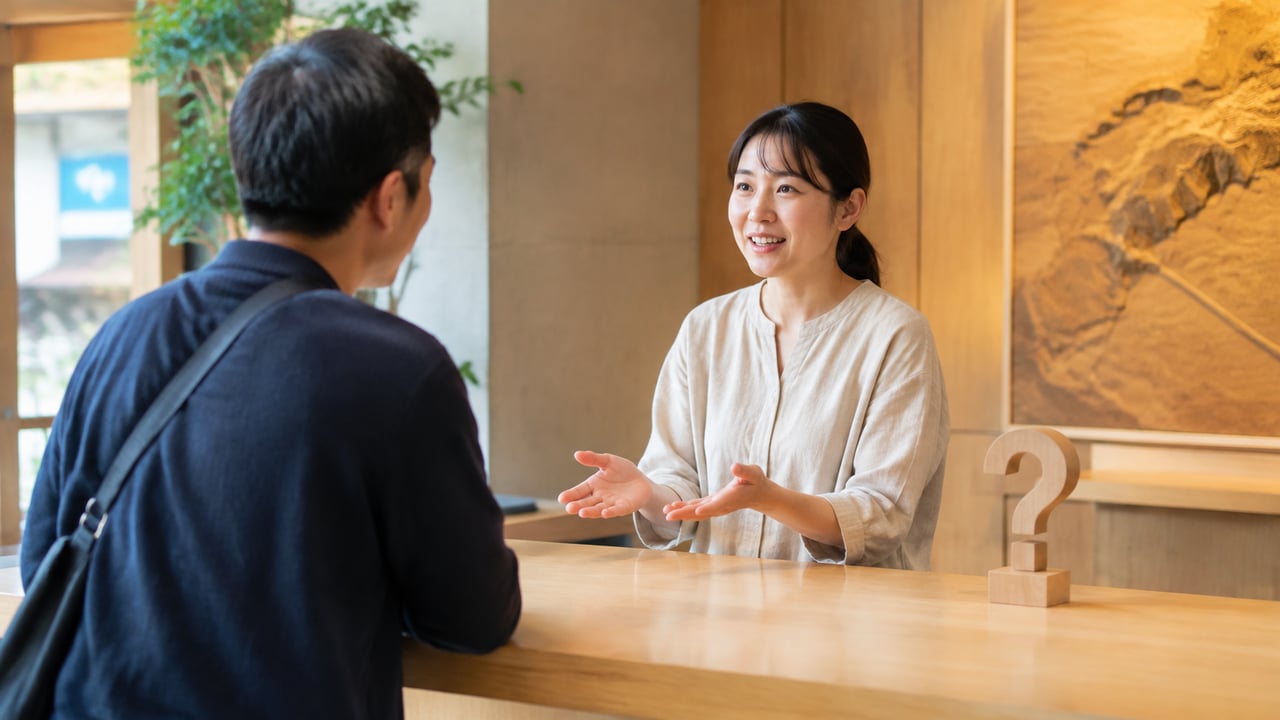

Quick Answer: This hub is for foreign residents who see Japanese talk change between work, social life, school, family, and service counters. These are tendencies, not laws. Theory, terms, and procedure live in the child articles. Here you only get how the room shifts.
Who is this guide for?
People who notice that the office is indirect while a dinner is not, or that shop talk does not match friend talk. The frame lives in
High-Context vs. Low-Context
. Labels live in
Key Concepts
. Procedure lives in
Practical Communication Strategies for Foreigners
.
What follows is a common pattern, not a rulebook. Industry, generation, and people differ. For contracts and safety, do not leave a soft phrase as the only record.
How do work and social talk differ?
At work, rank and seniority often show up in who speaks first. Meetings are sometimes described as confirmation of work already done offstage, not open debate. Dissent may wait for a private room or a preface. International teams and startups can ask for views from the start.
In social rooms, first meetings often lead with set greetings, and personal topics come later. Inside/outside groups are a common explanation for a change in politeness. Drinking is sometimes said to loosen talk. It is not required, and people who skip it should not be boxed out.
Indirect speech lives in
Verbal Patterns
. Silence and faces live in
Non-Verbal Communication
.
What about school and family?
Schools and universities can keep a teacher–student distance closer to workplace rank. Some classes wait for a name to be called; seminars may ask for a view. Effort and preparation often show up in the praise. That is a tendency, not a code.
Inside a family, talk can be more direct than outside. Other homes keep formality toward elders. Households differ. Do not freeze one picture of a Japanese family.
History and thought live in
Cultural Roots
.
What set phrases show up in customer service?
Counters and shops often lead with set greetings and apologies. Politeness is described as a way to hold the relationship. The Agency for Cultural Affairs treats honorifics as language that adjusts the relation and the scene.
“The customer is god” is a slogan, not a statute. For complaints and safety, short facts and the next step beat a ritual line. Wording lives in
Essential Phrases
.
How do you notice the room has changed?
Useful clues: politeness level, who sits where, and a topic shift. A work dinner can drift toward private talk. Treat clues as hypotheses. Matching the most senior person in the room is often the safer default.
You do not need every context at once. Start with the office you are in, or the counter you use. Cross-cutting questions live in
the FAQ
.
FAQ
Same politeness everywhere?
No. First meetings, outside the company, and counters often stay more polite. Match colleagues after you watch.
Do younger people skip the shift?
Industry and international experience often matter more than age.
Which room first?
The workplace you have, or a procedures counter. Theory can wait.
Can I ask which style to use?
A private ask to one trusted person usually costs less than asking in the middle of the room. There is no official exemption.
Read next
High-context vs. low-context
Cultural roots
Key concepts
Verbal patterns
Non-verbal
How to check and decline
Phrase list
FAQ
Sources
- Agency for Cultural Affairs, Guidelines for Honorifics (2 February 2007) (verified 2026-09-09) — honorifics as relationship-adjusting language across scenes.
- Agency for Cultural Affairs, honorifics policy pages (verified 2026-09-09) — national-language honorific guidance.
- Agency for Cultural Affairs, National Language Opinion Survey (verified 2026-09-09) — official surveys of language use; not an official map of these contexts.